See our paper on pyoverdin localization at the cell’s pole.
Title: Polar accumulation of pyoverdin and exit from stationary phase
Authors: Clara Moreno Fenoll, Maxime Ardré, Paul B Rainey
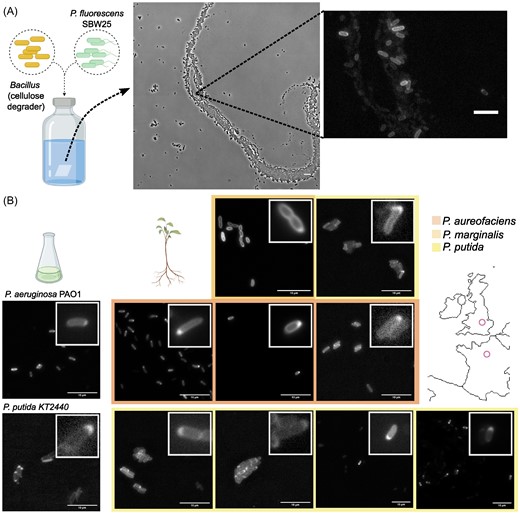
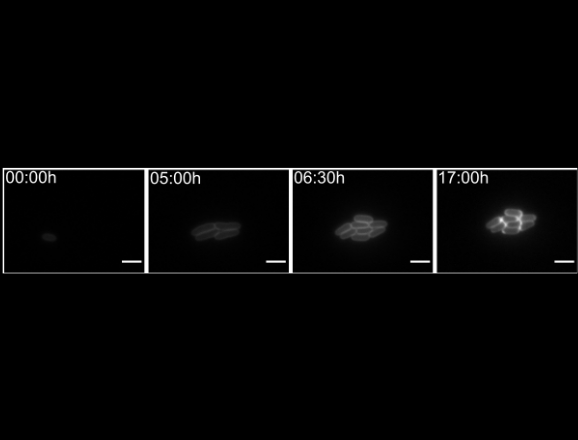
Bacteria secrete extracellular products that enable nutrients to be obtained from the environment. A secreted product of relevance for medicine, agriculture, and biotechnology is the iron-chelating siderophore, pyoverdin, which is produced by members of the genus Pseudomonas. By analyzing the behavior of single cells we show that on cessation of cell division, pyoverdin localizes to cell poles, but is then released to the environment prior to resumption of cell growth. Of particular significance is the ecological relevance of this behavior: cells that accumulate the siderophore resume growth with minimal delay. Our study reveals a hitherto unrecognized dimension to the biology of Pseudomonas that may prove central to understanding the broader ecological and physiological relevance of pyoverdin.