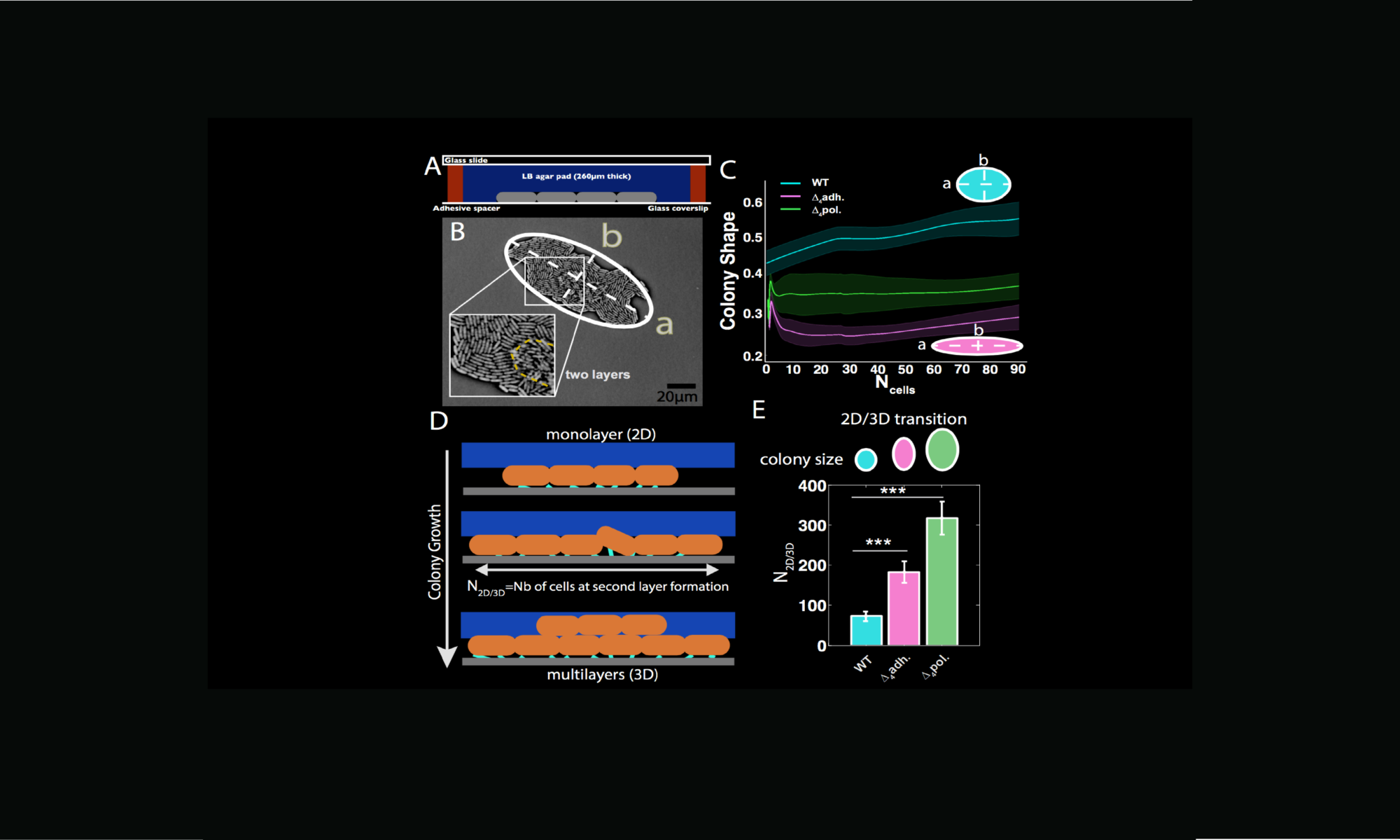
“Surface colonization underpins microbial ecology on terrestrial environments. Although bacterial adhesion has been extensively studied, its dynamical contribution to colony expansion remains largely unexplored. Here, we used laser ablation and force microscopy to monitor adhesion at the single-cell level. We show that adhesion forces of rod-shaped bacteria are higher at old poles. This asymmetry induces mechanical tension, and drives daughter cell rearrangements, which eventually determine colony shape. Informed by microscopic data, we developed a quantitative model for colony morphogenesis that fits experiments, and predicts bacterial adhesion from simple time-lapse measurements. Our results demonstrate that patterns of surface colonization are shaped by force relaxation events derived from an asymmetric distribution of adhesive factors at cell poles.”
Title: Asymmetric adhesion of rod-shaped bacteria controls microcolony morphogenesis
Authors: Duvernoy Marie-Cécilia, Mora Thierry, Ardré Maxime, Croquette Vincent, Bensimon David, Quilliet Catherine, Ghigo Jean-Marc, Balland Martial, Beloin Christophe, Lecuyer Sigolène, Desprat Nicolas